


New Dahlia Variety Highlight
Usually I wait until a little later in the season to highlight some of my new (to me) varieties but - Why wait? I’ve noticed some good ones so I thought I’d share.
Everything listed here is new in our trial field this year or on a year 2 trial.

Innocence- I grew this back in 2020 but unfortunately lost the tubers. I’m glad to have her back because she’s gorgeous. 5-7” wide, soft blush, gets softer as she ages, great vase life. She would be a stunner in the garden. It’ll be a few years but this will be in future tuber sales for sure!

Jabberbox. Such a cute name and great dahlia too. 3-4” wide, great color variation, strong stems, tall but not overly so- big enough to have presence.

Beatrice. Soft copper bronze grown in the field, soft bronze based peach grown under cover (as shown here). Early, first to bloom in our field this year. Strong stems, not super tall plant, average height.

Valley Rust Bucket. This one is going to give Brown Sugar a run for it’s money in the “rust” color category. BS is darker but I like the color variation on the petals of VRB better. Earlier blooming, strong stems, 3-3.5” plant height. 2.5-3” wide bloom
Just a few that I’ve taken notice of this year! What’s your new favorite? Drop me a line and let me know!
The Two Biggest Mistakes Beginning Dahlia Growers Make
You spent all winter stalking websites for that elusive tuber and drooling over the gorgeous pictures. Then spring came and you planted your tubers but now it’s August and it doesn’t seem to be working out like you dreamed right?

It’s pretty common to feel like you missed the mark when trying something new. For some reason, we have this expectation of getting it perfect the first time. This is totally unreasonable and if we are honest with ourselves, we know we shouldn’t be beating ourselves up over it! So let’s just take a moment and acknowledge that we are beginners and first timers make mistakes. And that’s perfectly OK!
When it comes to dahlias there are two mistakes that everybody makes. And full disclosure here- it took me more than a year or two to really master these two things. (Translation: give yourself time and grace)
Mistake #1: Support! Dahlias just like people need support. Beginners often forget to support or think about it too late. I was always in the too late crowd.
There are different methods: If you are growing a small number, then stakes or tomato cages work well. If you are growing for production then I recommend horizontal netting or using the Florida weave method (Google this if you don’t know what it is- you need to see a video to understand it). If you grow in a 3-4’ wide bed- then go the netting route. Stakes should be 5-6’ apart down the row and make sure they are sturdy. I recommend rebar or fiberglass or very thick wood stakes. I’m not a fan of wood stakes in my heavy clay soil- they just rot by the end of the season. I use all rebar. Also make sure you are capping that rebar somehow so you don’t poke an eye out during harvest.
If you grow 1-2 plants wide in long rows, then the Florida weave works well. Tying dahlias in on wide rows has never worked well for me - too much room for them to move around. But if you grow long rows, 1-2 plants wide then tying dahlias works great! You can also use netting on skinny rows too- you may just have to cut the width of the netting to size.
Last thing about support— You need to do it pre-emptively. If you are using a stake or tomato cage, then install it after planting your tuber. If you wait until later, you may stab your tubers as they are growing/multiplying under the ground. For netting, I put it on after I pinch my dahlias. It’s easier to pinch if the netting is not in the way.

Mistake #2- Food and Water! Dahlias are hungry plants and beginners don’t realize how hungry they are— think teenagers on a growth spurt kind of hungry! They need lots of water once they begin setting buds. Make sure your soil is draining well but daily water is necessary if you live in a hot climate for sure.
Weekly feeding until about the end of September if you want a regular supply of blooms- especially if you are growing for production. You can foliage feed, fertigate if you have an injector, granular, or liquid poured at the base of the plant. I’ve used all of the above except the fertigator (One Day, One Very Happy Day!)
Granular feeds are easy and I used to use them a lot before I began planting in fabric. The important part about granular feeding is that you need to water it in. I got to be a pro at getting my granular feed spread right before a tropical storm would come through. Granular is nice too because it can be time-released depending on what you use so it’s good for those who want to spend a bit less time on feeding their plants.
Foliar feeding is definitely one of the most common and also easy to do. You can put it in a bottle and spray if you are doing a few plants. Or get a backpack sprayer— this is what I recommend if you grow for production. I love mine. I use the My 4 Sons brand- Battery powered, reasonable price, charge lasts forever!
Liquid applications work well- although probably better on a small scale. Large scale liquid applications would need to go through fertigation— One day I’ll have one!
So what to feed with? Ideally you took a soil sample before planting and amended accordingly. This gives you a base from which to start. But when is life ever ideal?
In general, dahlias need a complete fertilizer when they are growing (before bud formation) and a fertilizer high in phosphorus and potassium when they begin to set buds. I really like Neptune’s Harvest brand- they work well and are easy to find. Also Alaska Morbloom 0-10-10 is really good for the bud/flowering stage. Most fertilizers that work well for roses or tomatoes are suitable for dahlias too. They have similar feeding needs.

Most likely if your dreams are not materializing, they just need a little TLC. Go stake those plants this weekend. Make sure they are getting plenty of water and give them a nice meal. They’ll reward you with gorgeous blooms as the weather begins to cool this Fall!
Are you signed up for our Dahlia Lovers Newsletter? Go sign up for more great dahlia growing tips!
Dahlia Planting Dates for Hot Climates
A few months back I asked for a bit of help from the growers of the Warm Climate Dahlia Growers Group on Facebook. I asked them to share their growing zone, general geographic location and planting dates. I’ve compiled them into a spreadsheet that gives an overview of planting dates for Zones 6b-10b.
You can view the chart below. As always, consider your unique climate and also your last frost dates. If you’d like to contribute to the data, please send me an email via our Contact page.

What's Eating My Dahlias- Part 2
Dahlias are gorgeous! Unfortunately all the bugs think so too. Let’s talk about how to deal with some of the most common pests: grasshoppers, thrips, tarnished plant bug (TPB), cucumber beetles, and leafhoppers. These methods work well for the home gardener and small scale grower. I use organic pest control methods. There are plenty of other options out there but I choose organic on our farm so that’s what you’ll find covered here.
Let’s start with the most full proof pest control method: Prevent the pest from even touching your dahlia. This is accomplished by the use of organza bags— you know the kind they use for wedding favors.

These work extremely well for a cut flower operation or cut flower specific garden. They block everything from getting your blooms. However if you are enjoying your dahlias in a backyard garden style setting, you may not want to look at “dahlia lollipops” all the time. Kinda’ diminishes the joy of it.
Grasshoppers are the hardest to control in my opinion. There aren’t many organic sprays that will touch a hard bodied insect. The best control for a grasshopper that I’ve found is attracting birds to your garden. Birds love to eat grasshoppers. Adding a water source, even a small one, is a great way to attract birds.
If you have chickens, even better- they will devour them. Just make sure your plants are big enough to take a little chicken abuse. Usually grasshoppers don’t become a menace until the plants are blooming so at that point, allowing chickens into your dahlia patch can work. I used to use this method a lot until a fox got all our chickens.
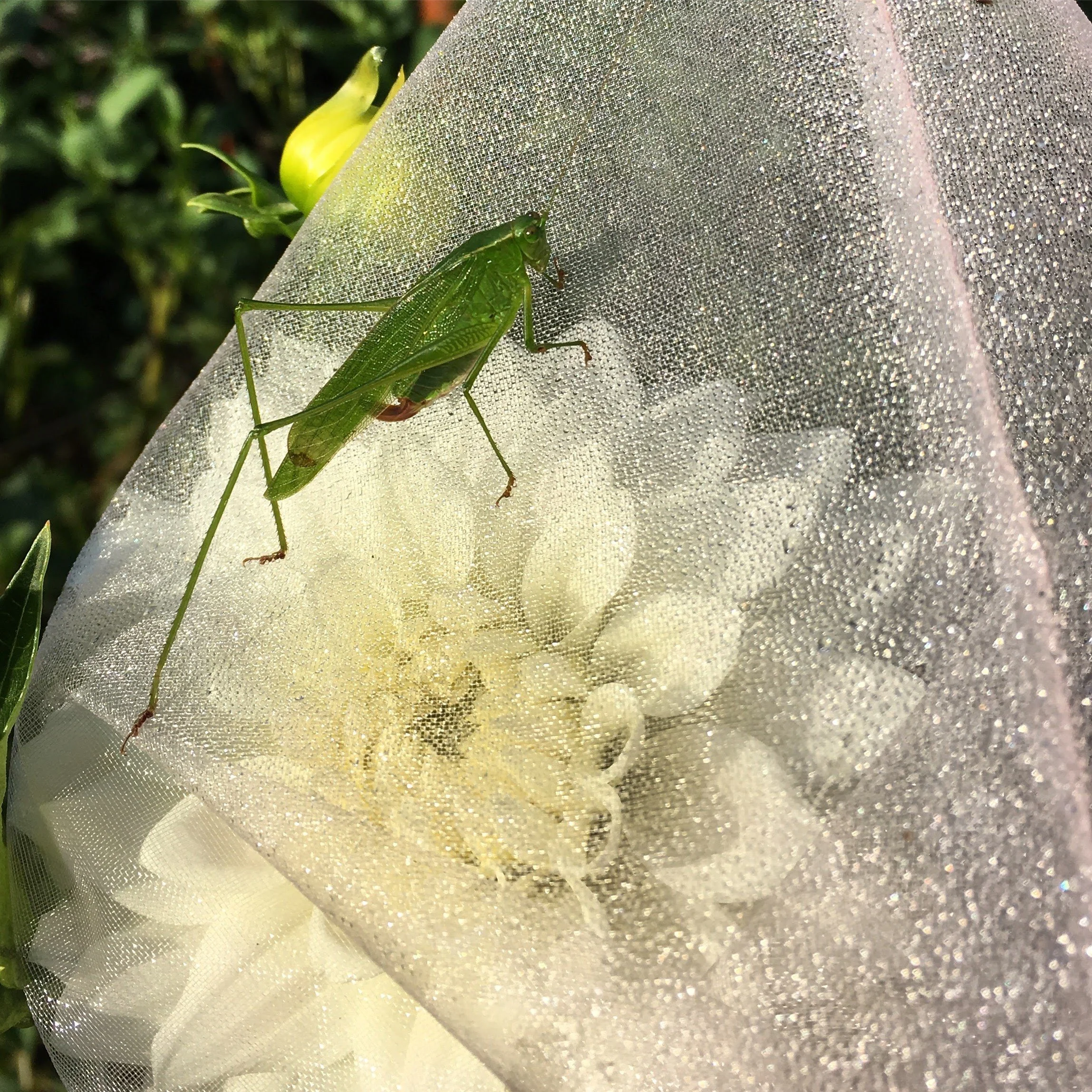
Botanigarde Maxx is the only spray I’ve ever encountered that will kill a grasshopper and even it’s hit or miss— Grasshoppers move quickly so it’s hard to get the spray on them. If grasshoppers are a serious issue for you, consideration of the organza bag will have to be done. It’s the most effective method for grasshopper control.
Thrips are an annoying nemesis when it comes to dahlias. Timing is one of the best methods I’ve found for dealing with them. In my climate, thrips are a bad issue from mid- May to mid summer. Then they die back and aren’t found in high infestation level numbers. Thrips are probably the number one reason I don’t grow early season dahlias. Organza bags are reasonably effective against them but thrips are so small that they can get inside the bags sometimes. Various sprays will work on them and keep the populations under control but having perfect light colored dahlias is a challenge during thrip season. If you need dahlias during thrip season, stick with brighter colors- thrips are more attracted to whites/light colors.
A pyrethrin spray or a spinosad spray is a pretty effective tool against thrips. I highly recommend alternating what you spray. Also one round of spraying won’t cut it, it’s something you have to do regularly during the pest’s season.
Tarnished Plant Bugs and Leafhoppers - these 2 can be controlled by the same method. The yellow sticky trap is my best friend. Now— don’t freak out. I know, I know- small animals (birds, lizards, etc) can get caught on these and die. However, I’ve learned you can still use them but you gotta get crafty in how you hang them.
A yellow sticky trap is a card coated with a sticky substance that attracts particular pests. It’s great at catching small flying insects. You want to keep the card size to no larger than 3x5. I punch a hole in mine and hang them below my netting so that they are in the main plant canopy. Keeping it down in the plant canopy is key so that it’s less likely to be in a bird’s flight path. Also, I’ve learned you want to make sure the card can swing. This keeps lizards off of them. If you fasten it tightly so it’s immobile, baby lizards will crawl on it and not be able to get off.
Leafhoppers are important to control and they are often overlooked because they don’t show physical damage to your plant quickly. They do chew on the plant but it’s not super noticeable. However, they are vector insects- meaning they can take a virus from one plant to another. And in this day and age, when dahlia viruses are becoming more common, controlling leafhoppers will help protect your dahlia plant stock.

Cucumber beetles- other than grasshoppers, these are probably the most destructive of dahlia pests. They can chew a bloom incredibly fast. If you begin to see them in your field/garden, you want to act quickly because this is a pest you don’t want getting out of hand.
Once again, organza bags are the most effective method. But a spinosad or pyrethrin spray will work too.
One of the best things I did several years ago was to stop growing plants in the amaranth and squash plant families near my dahlias. Amaranth is a magnet for cucumber beetles. So much so that I’ve completely cut it from my crop list. If you can’t do that, move it as far from your dahlias as possible. I do still grow small quantities of squash and cucumbers in my veggie garden, but I have it as far from the flower field as I can go (and still be on my property).
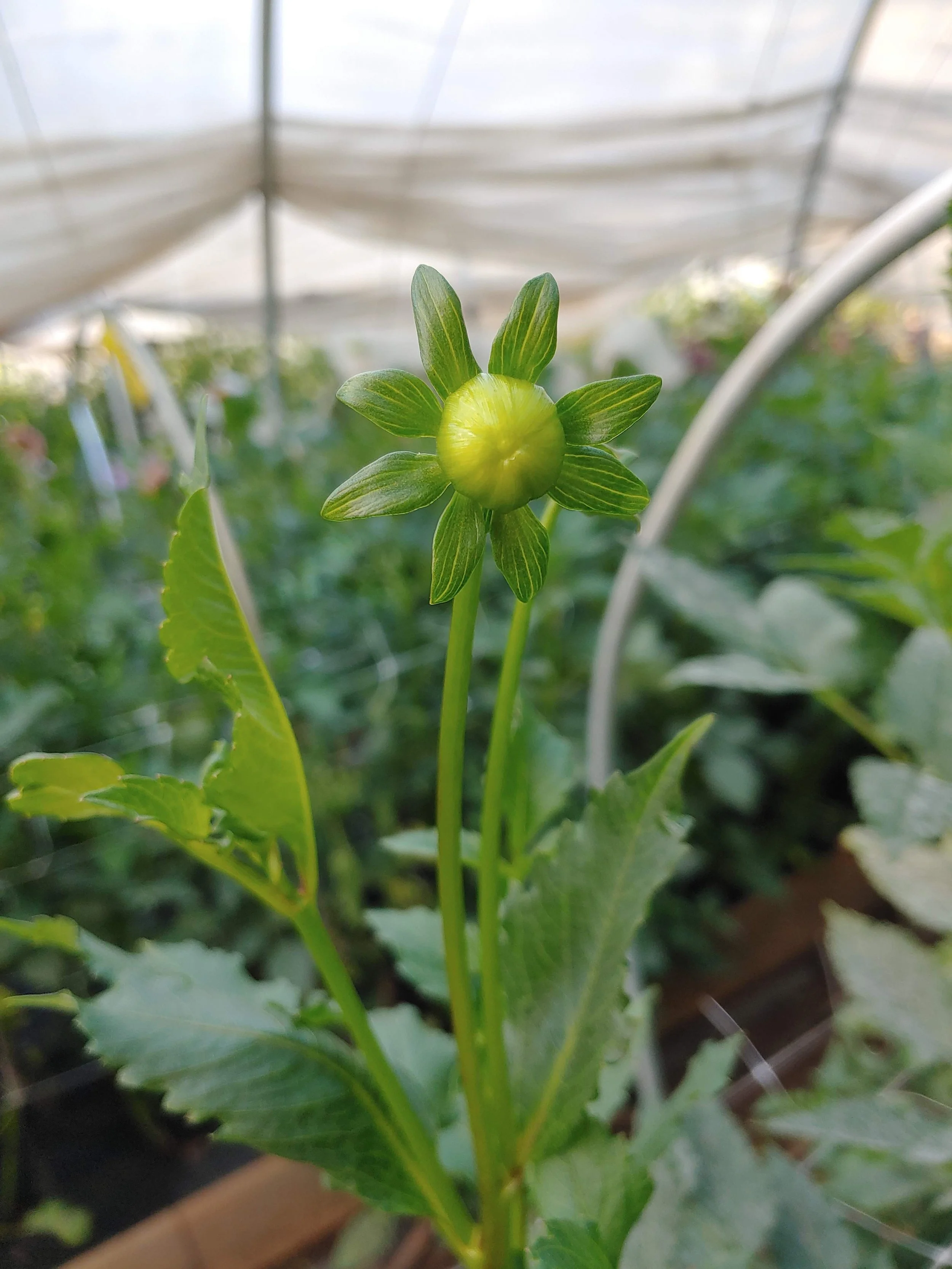
So to sum it up- if you want a flawless dahlia, put an organza bag on it before the bud begins to open (in the green stage as shown in the picture above). If that option doesn’t appeal to you, then sprays and strategic plant placement are your best options. Also employ the sticky trap. Not only does the trap catch a lot of pests, but it’s pretty non-harming to you and others.
Is Something Eating Your Dahlias? Let's figure out what it is!
It’s that time of year. You’ve been watching with great anticipation as your dahlia bud begins to show color. It opens so slowly— or so it feels because it’s the first one and you’ve been waiting months to see a dahlia again (or maybe for the first time! Eeek!!) Then one morning you walk out and you see a hole in your leaf or the corner has been chewed!
How Dare They?? How dare some little creature enjoy breakfast from your dahlia petal!

Image by Valerie Miros- Grasshopper Damage
Don’t worry— there’s hope! The bugs are not going to decimate your entire garden (despite how it may feel!).
So what do we do? First, don’t panic! Seriously, in the grand scheme of things, a nibbled petal is not really a big deal. You may roll your eyes and say I know— But you wouldn’t believe how upset I see some people get over a chewed petal.
Second, you gotta’ figure out what’s eating it? Inspect your plant, turn over the leaves, look carefully between all the layers and see if you can find the culprit. Also notice what might be flying around the plant . Often times, the culprits will fly up when you ruffle the leaves.
Take pictures of the damage. I find that if I need to Google to figure out the culprit that a picture is better than my memory.
No sign of anything? Then there are a few culprits who you don’t see but they love a tasty petal or leaf. Slugs are a big one, especially on new growth or the sprouts just as the dahlias are peaking out of the ground.
Grasshoppers— if you see petal damage where it looks like something just took a dull knife to several petals at once and chopped them off- probably grasshoppers.

Are your dahlias turning brown especially where the petals meet the center? Most likely thrips. Thrips are very small brown bugs which are hard to see but cause loads of damage- they really like white/pastel colored dahlias. If you think you might have thrips, but aren’t sure- shake your flower over a white piece of paper. The thrips will fall out and be brown specks.

Cucumber beetles are another common pest. A lot of people grow vegetable gardens near their dahlias. Cucumber beetles love dahlias and anything in the squash family. The squash family (cucurbits) attract the beetle and then it finds its way over to your dahlias and has dessert from your pretty cafe au lait petals! Cucumber beetles can be very devasting to a dahlia field. So much so that I’ve stopped growing anything in the cucurbit family within 100 yds of my dahlia field. This practice has significantly reduced the number of cucumber beetles that I see each year.
These are a lot of the common pests that do visible damage to dahlias. However there are some that don’t appear to be hurting anything because they don’t chew but can be very detrimental to your plants.
Leafhoppers are one. They are small green bugs that hop from plant to plant. They do suck sap out of your plant. Leaf hoppers are a vector insect- which means that if a dahlia has a disease/virus etc. they can carry it to another plant. So while you may not see much visible damage from leafhoppers, they can be very detrimental, especially if you are growing a high number of plants.
We’ve identified a lot of the common pests that plague our dahlias- so what do we do about them?
The answer to that is coming up in our next article because this is too much for one post!
If you are having issues with a pest that we didn’t name here, see if you can get a picture of the pest or the damage and send it our way! You can submit it here.