


The Mulch Chronicles- Part 1
I’ve said it before and I’m sure I’ll say it again but part of why I farm is the desire to experiment!
Weed pressure is very high on my farm so I have to have a solid system for controlling weeds. And preferably one that doesn’t require a ton of time either!
I began planting my dahlias the same old way this year but I knew in my gut that I wasn’t happy with it. I began researching, talking to other farmers, and just generally thinking about the process. The longer I farm, the more I question everything I do. There’s so much labor that goes into growing that I’m constantly looking for innovations and refinement.
So today begins a multi-part series on mulch! (Didn’t think I’d find enough to say about mulch for several posts but with everything that’s been on my mind- I don’t think it’ll be a problem)
So before we get to what I’m experimenting with- let’s take a look at where I started.
I wish I had a picture from the summer of 2018. But maybe I can describe it: mid July, 90+ degrees everyday, full sun, sweat dripping everywhere. I’m staring at a bed of weeds so high that you wouldn’t know there were dahlias growing in there unless I told you. This is what my dahlia field looked like!
I’m pretty sure I lost it several times that year. This is when I began thinking about planting in black fabric mulch. (I did have the dahlias mulched with wood chips— but as you see above- it didn’t work) Over the winter, I began burning holes into black fabric mulch for each dahlia bed. I had resisted the black fabric growing trend for years because I had a lot of reservations about it. But I was desperate!

These raised beds are 4x16 and each bed holds 64 plants at 1’ spacing. And up until this past week- this is the system I’ve used. And it worked reasonably well —until last year.
Last year’s weather showed a lot of the downsides to black fabric mulch. The things I feared began to come true! The extreme heat and drought we faced didn’t interface well with the black fabric. I lost hundreds of tubers that basically just burnt up in the ground.
I had to pull out all my tricks to cool the field down- overhead watering during the day. We also used Surround crop protectant (this is a kaolin clay based spray that is used by a lot of organic fruit farmers). The Surround spray is white so it not only protects your crop but also reflects light. We sprayed the fabric and the plants.

This picture is from late June of 2022. As you can see, you have to keep spraying as the plants grow. Also a lot of rain will wash it off (but it will last through some rain- just depends on how much). Also once your plants begin to bud you have to discontinue use because nobody wants a white chalky stem! But it helped get me to the point where the plants where big enough to shade the fabric.
Now do I think black fabric is a bad idea for hot climate growers? Well— it all depends. If you are a more extreme hot climate (zone 8 plus), then it’s probably not going to be the right thing for you. But I’m a zone 7b and I run this kind of weird borderline. Things that work for cool climates can sometimes work here as well as the really hot climate methods too.
I do think that if you plant early enough in spring to get a thick plant canopy over your fabric that this system could work well for a hot climate grower. But I don’t like planting super early because I don’t want blooms in July. I will say that the black fabric does a fantastic job at keeping the weeds down. We usually make one weeding pass through the field when the plants are around 18” tall and that’s about it for the season.
But after last years extreme heat and drought, I knew I had to find another way.
I’m experimenting with 2 methods this year: straw mulch and cover crop mulch. We’ll talk about straw first (cover crop mulch is part 2)
So why haven’t I tried straw before? It does seem like the obvious choice. Well I did try it - many years ago and not long after laying it down, I had a nice crop of green grass growing under my plants. I soon discovered there wasn’t a clean weed free source of straw locally to me.
I mentioned this to my grower friend, Lori (of Broad River Blooms). She, being the generous person that she is, shared with me her straw source.

For my local friends, you can order this through Tractor Supply stores, possibly Lowe’s too. It’s an extremely fine milled straw. It makes a very dense mat over the soil. It also has a tackifier that keeps the straw together and helps prevent washing away.
I decided at first I would try it on one bed. I put it down about 2 weeks ago and began keeping tabs on that bed. Watching for weeds (too soon to tell on that part) but also checking moisture levels. The black fabric tended to get so hot that the soil was drying out underneath it. After a few days (with no rain and only 1 run of the irrigation system), I did a moisture check. It was still moist underneath the mulch. The bed next to it with black fabric was bone dry!

Since this picture was taken, the dahlias have begun to poke through. We have also had a heavy rain— the straw stayed in place! Now we wait to see if it keeps the weeds down after all that rain.
(BTW- I’ve figured that one bale will cover at least 2 4x16 beds).
Another thing to think about when using any type of mulch while growing dahlias is removal. If you dig your tubers in the fall, you must think about how the mulch will affect that process. The straw seems easy to handle. If it’s too thick, we will rake it off the bed. With the fabric mulch, we had to be very careful pulling it off to make sure we didn’t knock the labeling tags off our plants.
Another bonus to using a natural mulch is that it will break down and add organic matter to the soil over time.
The only cons I’ve thought of for the straw mulch so far are — expense. The black fabric is reusable so it’s a one time expense. But I’ve done the math and the straw is still affordable within my crop projections. Second, there is always a risk of residual herbicide when bringing something like this into your farm. I do feel better about buying this brand rather than sourcing straight bales. I know that straw bales are often purchased from many sources and therefore there is less control over what gets sprayed on the grass before it’s cut.
Over the next week, I am going to be removing the fabric from the beds we’ve already planted and adding the straw mulch. The tubers are just beginning to sprout so if I do it now, I won’t damage the plants.
I really hope the straw keeps the weeds down because if not, it’s going to be a lot to keep weeded!
Next time— using cover crops as mulch. Let’s just say this is where it gets interesting (and a bit creative)!
Best Dahlias to Plant for Continuous Bloom in Your Garden
A few weeks ago a reader asked “What dahlias can I plant so I can have continuous bloom in my garden throughout the whole dahlia season?”
What a fantastic question! And to be honest, I thought it would be a quick to answer type of question, but then I really got to thinking about it and realized it was going to take a bit of calculation. So I turned to my trusty spreadsheets and began pulling data.
I kept careful records of what weeks I planted certain varieties this year. Then I took pictures when the first bloom opened. So I was able to pull the days to bloom from that information. (And it took awhile for 100+ varieties)
So here’s what I would plant for a continuous bloom in your dahlia cutting garden.
(Fine print: I’m zone 7b, South Carolina. Hot and humid climate, heavy clay soil- best dahlia blooms come from Sept to mid October. All the days to bloom have been rounded to the nearest 5. I don’t record the exact planting date or the exact first bloom date. From years of experience I’ve learned that days to bloom (DTB) varies each year due to varying growing conditions. But if you get the week you planted and the week it bloomed, you can get an average that you can use.)
Early Bloomers (60-80 DTB) : Peaches N Cream, Creighton Honey, Linda’s Baby, Mingus Toni, Mystique, Blizzard, Cornel Bronze, Brown Sugar
(pictured l to r)


Avg 60 DTB = Mingus Toni, Mystique
AVG 70 DTB = Creighton Honey, Peaches N Cream
AVG 80 DTB= Linda’s Baby, Blizzard, Cornel Bronze, Brown Sugar
Mid Season Bloomers (85-110 DTB): Bridezilla, Miss Amara, Hapet Champagne, Sonic Bloom, Wine Eyed Jill, Brookside Cheri, Cafe Au Lait, Hollyhill Black Beauty (pictured l to r)


AVG 90 DTB = Bridezilla
AVG 95 DTB = Miss Amara
AVG 100 DTB = Hapet Champagne, Sonic Bloom, Wine Eyed Jill, Hollyhill Black Beauty
AVG 105 DTB = Brookside Cheri
AVG 110 DTB = Cafe Au Lait
Late Season Bloomers (115+ DTB): Southern Belle, Renato Tozio, Hamilton Lillian, Fiona, Marionberry Milkshake, Hapet Perfekt, Dreamcatcher, Bubbling Over (Pictured l to r)


AVG 115 DTB = Renato Tozio
AVG 120 DTB = Bubbling Over, Dreamcatcher, Hamilton Lillian
AVG 130 DTB = Southern Belle, Fiona, Marionberry Milkshake, Hapet Perfekt
I do want to add a caveat here: It was a very hot dry summer which definitely had an effect on days to bloom. I know this because we succession planted a few varieties and saw some significant variation in their bloom times and it correlates to the weather patterns when they were planted and establishing. Also some of the above varieties were first timers in my garden— I like to have a variety for 3 years before I say definitively what it’s characteristics are. But I included some of the first timers here for added variety.
Please keep all these things in mind. Your climate will play a crucial role in the actual days to bloom. Also if a variety is new to you and you don’t know how long it’s gonna take to bloom- assume this: Most likely it will be a mid season bloomer because this is where most dahlias fall - in the 90-110 DTB range. Also the larger the bloom, the more time it takes (as a general rule).
I hope this helps you plan your dahlia garden for next year! Planning what new varieties I’m going to grow is one of my favorite parts about winter!!

My Favorite White Dahlias for Hot Climates
Whenever a new flower farmer asks me what they should grow- I always say- “Grow white.” You can never have too many white flowers. And I must admit, I really like a white dahlia. There’s just something about a pure clean perfect white dahlia- velvet like petals, a bit of sparkly dahlia glitter!
I’ve grown a lot of white varieties over the years to find the ones that really produce here in my hot climate and I’d like to share some with you.

Blizzard
Blizzard- You probably knew I was going to say this one. She’s been gaining in popularity for years now. Highly prolific, strong stems, good tuber maker (easy to divide too)- perfect size for all types of design work. What’s not to like? Aptly named- If you look down a row of Blizzard blooms, it really does look like a bunch of snowballs on sticks!

Ryecroft Jan
Ryecroft Jan- the ubiquitous white ball dahlia. You can never go wrong with a white ball dahlia- it’s a perennial favorite among my florist customers. Tallish plant, very strong stems, 3ish inches in diameter (larger in cooler climates I believe) and reasonable tuber maker- they store well.
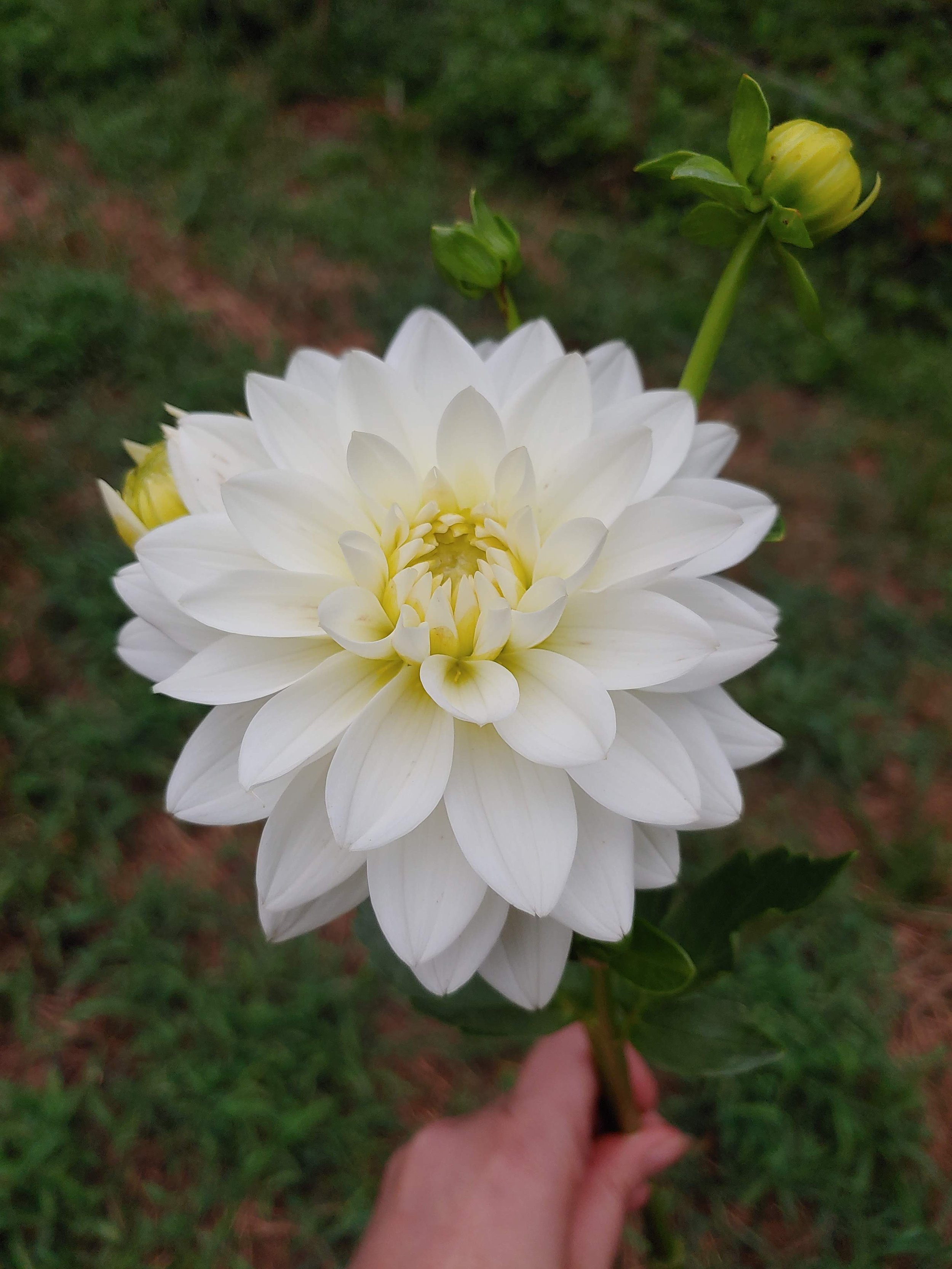
Karma Maarten de Zwaan
Karma Maarten De Zwaan- probably the most prolific decorative white dahlia that I know of! I get 3 strong flushes off this one in my climate (which does have a long growing season). The first flush can be a touch shorter than I like but I’ve learned to cut very deep into the plant. Then she’ll re-flush with taller stems. Strong but not thick stems- perfect for design work. Also the side buds will produce a decent sized flower if you miss the harvest window on the first bloom.
Her only downside is she’s a Karma. Karma dahlias were created a while back specifically for cut flower use and were patented. The patent doesn’t expire until 2026. This means you can’t propagate off your stock or resell it. I’ve been buying cuttings for years now - they work great! They are also available as clumps from tuber wholesalers and some re-sellers online.

Bridezilla
Bridezilla- I think this beauty was named to soothe bridezillas everywhere. There is nothing diva-ish about her. She’s white with a creamy center. In late season, if you let her really open up- the blooms become fluffy and peony like. She’s gorgeous! Medium height plant, 4-6” bloom, Good for a focal flower in design work.

Beaucon White
Beaucon White- She’s my favorite decorative style dahlia. Big enough to draw attention without being over-bearing. Lots of fluffy gorgeous layers to get lost in. Pretty much every brides dream white dahlia. Medium height plant, reasonably prolific for a larger bloom, great vase life!
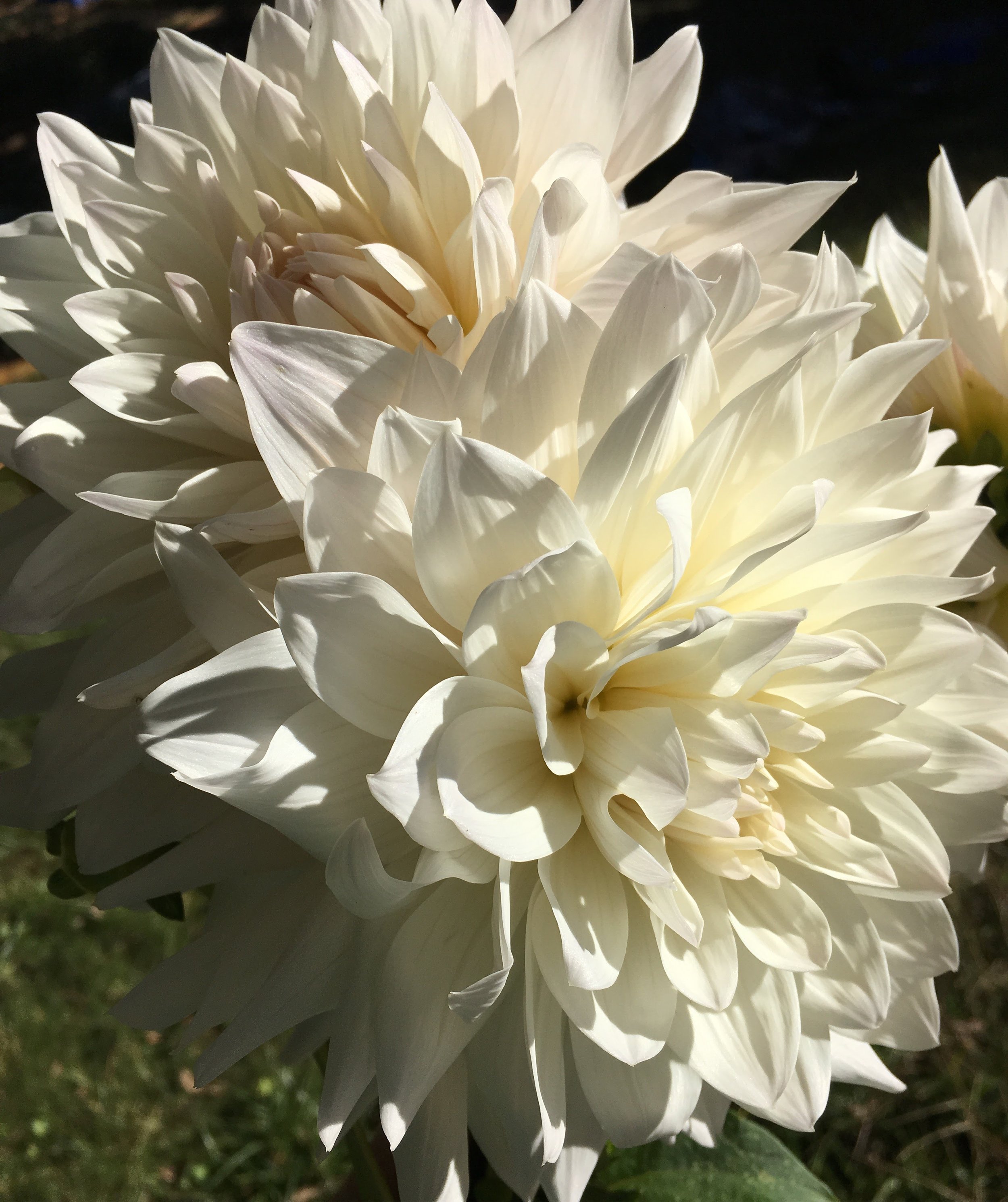
Roque Starburst
Roque Starburst- I’ll give an honorable mention to this one. She’s fantastic, sadly I don’t have much need for lots of large dinnerplate sized white dahlias. But if you do- give her a try. She can have a slight blush in the center sometimes. Tall plant with strong stems and good vase life - especially for a dinnerplate.
If you are growing for cut flower production, I recommend growing a lot of the first 3- Blizzard, Ryecroft Jan and Karma Maarten De Zwaan. Those will serve you well. Then add in some Beaucon white and maybe a few Roque Starburst. You’ll have enough fluffy white dahlias to satisfy any bride!
Love posts like this? Sign up for the Dahlia Lovers Newsletter to be the first to know when we publish a new blog!
Inviting Pollinators into your Dahlia Garden
So I’ll be honest, dahlias aren’t the first flower to come to mind when I think of blooms to attract pollinators. Usually it’s salvias, nicotiana, alyssum, yarrow and wilder looking plants. However there are some types of dahlias that work really well as pollinator attracting plants.
Anemone and collarette types will bring the bees into your garden. For a plant to attract pollinators, having an open center is an easy access method for bees to find pollen. Anemone dahlias have a large fluffy center full of pollen. Collarettes also have an open center that’s easy access.
I’ve been experimenting this year and grew Sandia Brocade (Anemone type) in the middle of all my cut flower dahlias. I haven’t been harvesting it like a cut flower so every bud has been able to open. I’ve been deadheading after I see the bloom has been pollinated. I don’t want seed heads to form because I want it to keep blooming as long as possible so I just keep deadheading.

Sandia Brocade in my Dahlia Field
Sandia Brocade is really the first dahlia like this that I’ve grown. But I have to say - I’m hooked! I love watching the sleepy bees early in the morning. I’m going to start growing more- just for fun! These types don’t always make great cut flowers- their vase life is pretty short. But they are worth it for their pollinator attraction value!
I wanted to find more varieties that worked well in a hot climate so of course I turned to my dahlia sister- Lori of Broad River Blooms. I know she loves these types and has grown a lot of them. Huge thank you to her for sharing some of her favorites! (She sells tubers of these too— sign up for her tuber sale email here.)

Platinum Blonde- Anemone type (Photo by Lori at Broad River Blooms)

Waltzing Matilda- (Photo by Lori at Broad River Blooms) Look at that color!!

Bloomquist Golden (Photo by Lori at Broad River Blooms) Non stop bloomer!

Dad’s Favorite (Photo by Lori at Broad River Blooms) Excellent Butterfly attractor

Claire De Lune (Photo by Lori at Broad River Blooms) I think this one is my favorite and is going on my must have list for next year!
I’m definitely making plans for more of these next year! I can’t wait to see all the beautiful pollinators they attract. I’ll be hitting up Lori’s tuber sale for sure!


Names from left to right: Bloomquist Sweet, Asahi Chohji, Ferncliff Dolly, April Heather, Pooh
Dahlia Planting Dates for Hot Climates
A few months back I asked for a bit of help from the growers of the Warm Climate Dahlia Growers Group on Facebook. I asked them to share their growing zone, general geographic location and planting dates. I’ve compiled them into a spreadsheet that gives an overview of planting dates for Zones 6b-10b.
You can view the chart below. As always, consider your unique climate and also your last frost dates. If you’d like to contribute to the data, please send me an email via our Contact page.
