


Cuttings Versus Tubers- Which is Right For You?
Rooted Dahlia Cuttings! They’ve become all the rage recently. If you are new to the dahlia world or have only grown tubers- you may be wondering what all the fuss is about?! Well let’s see if we can de-mystify that a bit.
First off- What is a tuber and what is a rooted cutting? Let’s get real basic here.
A tuber is the underground tuberous root that is produced by a dahlia plant during one growing season (they produce tubers on their first year, you don’t have to wait until the second year- that’s a common misconception I hear often.) The clump of tubers is dug up at the end of the growing season and then washed off and divided. They are stored through the winter and replanted in the spring.
A rooted cutting is when you take a tuber and pot it up early in the growing season. When it sprouts, you cut the sprout off and put it into a rooting medium, keep the humidity and temperature right and it will root in a few weeks. Within 6-8 weeks, you have a plant ready to put in your garden. You can keep taking more cuttings of this same tuber. This is how you can quickly multiply your own dahlia stock.

So which should you choose? Well there are pros and cons to both. Let’s take a look at some of them:
Spring time and receiving your tuber/cutting:
Tuber- You receive tubers in the spring sometime and then you plant when you past the last frost date for your growing zone. They hold pretty well if you need to wait a week or two before planting.
Cutting- You’ll need to care for them when you receive them and you’ll need to plant (or pot up) not too long after receiving it. However, cuttings are usually shipped when it’s the right time for your growing zone.
Planting your tuber/cutting:
Tuber- You’ll plant your tuber in the ground and then you wait- at least 2-3 weeks, sometimes more. Some varieties can take 6-8 weeks before sprouting although most are in up 4 at the most. In this time you have to make sure it doesn’t rot and also that your soil doesn’t get too hot (the heat temperature issue isn’t usually bad unless it’s high summer and your soil is extremely warm. I didn’t used to think this was an issue but I saw a lot of tubers cook in extreme heat this past summer on a lot of farms - even some on ours.)
Cutting- You plant it and you have a plant- cuttings definitely have an instant gratification factor. You will need to water it and care for it but it’s not any different than any other plant. Since you are planting a cutting, you have at least a 2 week jump on the tuber, sometimes more if it’s a later sprouting variety.
Growth Process:
Tuber- If your tuber gets established before harsh weather (heat, drought) comes, then it has a fairly good chance of making it through. However one thing about a tuber is that the plant will use the food provided by the tuber and can be slower to push out actual roots to keep feeding itself. This can have a significant impact on it’s ability to survive harsh weather conditions.
Cutting- A cutting has roots from the moment it starts to push them out in the rooting process. Then when it gets into the ground, it immediately starts to push roots out to establish itself.
This is where I saw the advantage of a cutting over a tuber for a harsh growing climate like mine. Our weather during the planting time is very erratic- some years it’s so wet, we can’t plant for weeks. Some years it’s so dry that the tubers take weeks longer to sprout. But when we started planting more cuttings, we were able to get a consistency in our crop that we hadn’t seen in years past. Not to mention the timing- we could plant wet or dry as long as the beds where prepared early.
Putting cuttings in and using a bit of irrigation if we were in a drought works better than tubers baking in hot soil. The water used to irrigate the cuttings also helps cool the soil. If the weather is the opposite- super wet- well the cuttings love the water and grow faster. You do need to ensure good drainage but good drainage is growing 101 for dahlias anyways.
Over the past 2 years we’ve made a move to planting more cuttings than tubers. Our field was over 60% cuttings last year. I firmly believe the resiliency of those cuttings is what got us through the extreme heat wave. The plants had good root systems because they were weeks ahead of the tubers. The tubers where baking and just disappearing under the soil because of the extreme heat.
Bloom time:
Tuber- Most bloom times you see posted are from planting a tuber in the ground and then growing to a full bloom
Cutting- You’ll get blooms sooner, by at least 2 weeks because you planted a plant instead of the tuber. So if you want color in your garden quicker, use cuttings.
End of Season:
Tuber- You cut back your plant and proceed to dig a nice clump of tubers.
Cutting- You cut back your plant and proceed to dig a nice clump of tubers. There’s a myth out there that rooted cuttings don’t produce tubers but in our many years of growing experience this has not proved to be true. Yes, sometimes you dig up a dahlia and there’s nothing there or there’s only your original tuber. But our experience has been that we get the same percentage of plants that produce clumps of tubers from rooted cuttings as we do from tuber planted dahlias. How many tubers you get at the end of the season depends on several factors (genetics, fertilization, growing conditions, etc. ) but whether you planted a cutting or tuber isn’t one of them.
So what do you choose? Honestly I would give both a try. I am seeing that cuttings are working better for harsh growing conditions. Also they allow us to keep our planting schedule which is important because we try to time our dahlias to bloom when our customers want them the most. If you decide to try both and you are planting them in the same area- plant all your cuttings at one end and your tubers at the other. Your cuttings will need water at first and you don’t want to rot your tubers out. This is what we do when we have a mixed bed of tubers and cuttings. Mixing in the same bed will really show you the differences and is a great way to observe and experiment.

Your Top 5 Blog Posts of 2024
It’s always fun to see what resonated with all you Dahlia Lovers over the year. So here are the top 5 most read blog posts of 2024!
Skipley Moonglow

Rooted Cutting Sale List 2025
It’s finally time for our first ever Rooted Cutting Sale! The Sale will be January 10 at 11 AM for newsletter subscribers. The sale will open at 12 PM without a password needed.
Here’s the list of what varieties we will be offering:
— It is possible that this list will change- we will probably add some to it and potentially remove 1 or 2. We will be checking all our stock in storage before the sale begins and adjusting the list accordingly.
20th Ave Gwen
20TH Ave Memory
Beaucon White
Blizzard
Caitlyn’s Joy
Copper Boy
Cornel
Cornel Bronze
Hamilton Lillian
Hapet Champagne
Hilltop Lost Treasure
HollyHill Black Beauty
Irish D Porter
Last Dance
Linda's Baby
Miss Amara
Peaches N Cream
Robann Butterscotch
Roque Starburst
Skipley moonglow
Sweet Fabienne
Sweet Nathalie
Sweet Sanne
Tahoma Curve
Totally Tangerine
Valley Rustbucket
Wine Eyed Jill
Pictures of each variety will be available soon in the shop. There will be multiple ship dates beginning late March. You can have your tuber order shipped at the same time. If you already have a tuber order with us, there will be a small up-charge if you want your cuttings order to ship at the same time but you won’t have to pay another shipping fee. More details to come!

Pantone Color of the Year 2025- Mocha Mousse
Honestly this color makes me hungry more than anything else. But since I can’t eat it- let’s discuss. Every year Pantone picks a color said to inspire design trends for the upcoming year. I’ve only occasionally felt like my life was affected by the colors they pick- sometimes I see them showing up in flower trends. Usually it takes a few years.
The 2025 Pantone color of the year is Mocha Mousse- capturing a global mood of comfort, connection and harmony. Personally I think they are living in another world— but maybe they are trying to inspire the forementioned moods. I was hoping for something bright and energetic. However, I do find it kind of fun to see what dahlias are in the yearly shade or which ones go with it. Since there aren’t any brown dahlias yet, we will have to go with coordinating colors.

Rock Run Ashley
Rock Run Ashley- I wouldn’t be sad about any trend that encourages me to grow more of this one. I’ve always loved it- forever in my top 10 personal favorites!

Cafe Au Lait
Cafe Au Lait- Of course I have to include this one because mocha and cream not only taste good together but they look good too!


Miss Amara and Yvonne- These two bring warmth to the palette without totally stealing the show.

Sweet Nathalie
Sweet Nathalie - In her cool tones with a tinge of icy blush would provide a cool colored contrast to the warm beigey brown of Mocha Mousse.

Cornel Bronze
Cornel Bronze- Probably about as close as we get to brown. But I think Cornel Bronze pairs beautifully with the Mocha Mousse color- that’s a Thanksgiving table color palette!
So what do you think? Are you a fan of the 2025 Color of the Year? Let me know- shoot me an email!

It was all Yellow….
I don’t think I’ve ever written a post about yellow dahlias…. but I’ve been searching for the elusive perfect yellow dahlia for years now. Yellow is really hard in a southern climate. Yellows tend to be very neon looking down here. And neon is not in vogue with my florist customers. They want warm yellow (gold) or soft yellow (buttercream)- but no neon.
I’ve tried a lot- I see a pretty yellow dahlia, I buy it and 90% of the time - I’m disappointed. Here’s a sample of the ones I’ve tried:
Creamy (puny and doesn’t grow well in high heat), Jo (great form but neon)
Polyventon Supreme (excellent plant and tuber maker but neon)
Winholme Diane (beautiful but no matter how many suppliers I try- the tubers always rot before the end of the season)
Blyton Softer Gleam (too late of a bloomer and stingy bloomer)
Citron Du Cap (neon)
Sunkissed (beautiful form but neon)
Tapioca (not quite yellow enough)
Golden Scepter (always blew it’s center)
Mary Jo (weak stem, great color though)
Honeydew (bright yellow)
That’s just a sampling. I’ve forgotten more varieties than I can remember. (Click the photo and mouse over it to see the variety name)


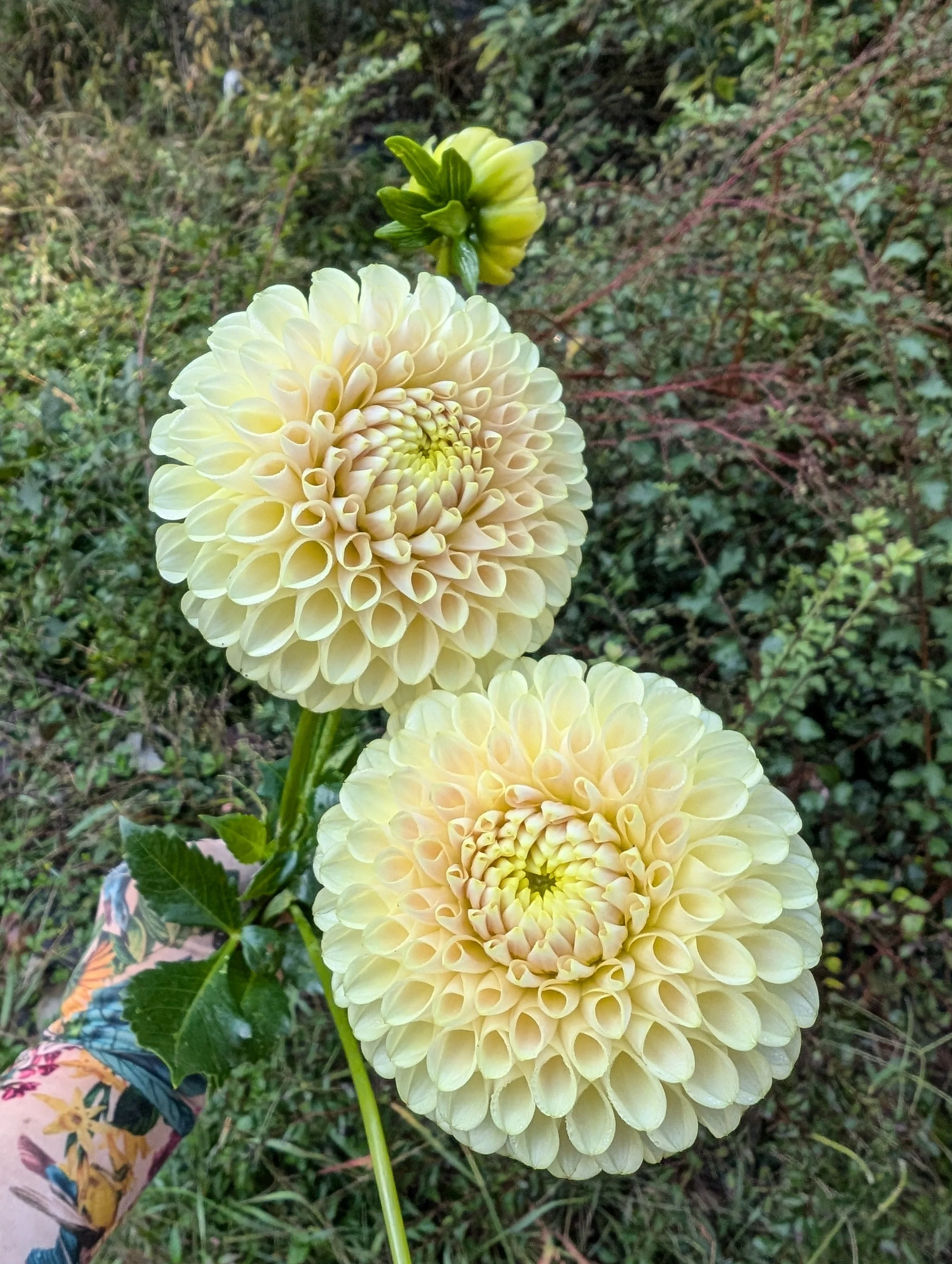
But this year- Finally!!! I hit upon one that I love. 20th Ave Gwen. And it was a total surprise. I bought 20th Ave Gwen, Softer Peach and Memory all at the same time. I began growing them out last year and for some reason I never saw the bloom on Gwen- either I missed it or it never bloomed. But I decided to take a risk and propagated it anyways. So glad I did— because this year it bloomed beautifully! Gwen has a softer yellow color with a bit of peach undertone as it matures. This really helps the tone down the neon. Now- I will say, pretty much any yellow will be bright and neon like if you let it bloom in high summer in extreme heat. There’s just no way around it. But I’m mostly looking for what a dahlia’s coloring does during September/October since that’s my prime bloom season.

20th Ave Gwen
I also rely on another variety for a bit of yellow when needed: Miss Amara. She can be a bit of a color changer- sometimes she’s more yellow with hints of pink (high heat) and sometimes she’s more peachy/yellow (cooler weather). But both colorways work for me!


I’m glad to have Miss Amara back on the farm in higher quantities this year. We had her built up as a major production variety 3 years ago and a ground hog came in and ate every plant and we completely lost her so I had to rebuild from scratch!
Tahoma Curve gets to be an honorary yellow because it’s always more yellow at the beginning of the season- it has the golden yellow factor down really well. (Left picture is early season, middle is mid- season, right is end of season)


I’m happy to be able to say that all 3 will be available in our Tuber Sale this year! 20th Ave Gwen will be limited (but most likely she’ll be available as rooted cuttings when those sales begin).
