

Rooted Dahlia Cuttings: How To: Part 1
I know that I’ve written on this before but I’ve learned a lot through the years and wanted to share an updated tutorial of sorts on taking dahlia cuttings.
This is Part 1:
To begin: You are going to need a few things-
1. Grow lights- You can use ordinary shop lights. I suggest one warm and one cool bulb to get a broader spectrum of light. You can also buy actual grow lights (I’ve gotten affordable ones through Sunco recently). But unless you are taking these cuttings during a time of year where you can do it outside, you’ll need lights of some form.
2. Rooting medium and containers. You’ll need some sort of container to root your cutting into- I suggest getting some plug trays. The container doesn’t need to be really big, in fact it’s better if it’s not. It would take a long time for the cutting to fill up a 4-5” pot. So a plug tray that’s an inch or two in plug size is ideal. Greenhouse Megastore has great options.
Rooting medium can be many things and I suggest trying them all if you are brand new to this. Some people like a good quality potting soil, some go into straight perlite, or even sand. Some people like a custom mix of all three. I’ve even seen people use a small vase of water. Personally I like a potting soil mix that is heavy on compost and peat. This holds water well. You don’t want your media to dry out too fast.
3. Right conditions: You’ll need somewhere that can be kept between 65-70 degrees. You can use a heat mat under your cuttings. You can put them in a room with additional heat. You are looking for the soil temperature to be in this range.
You’ll also need humidity. Remember the cutting has no roots at first so you have to keep it moist so it won’t wilt. You need to keep the humidity high enough for it to not wilt while it’s forming it’s new roots.
4. Patience- Yes, this activity requires a bit of patience and perseverance. There’s a good likelihood that the first ones you try- some won’t work. 100% success rate almost never happens. We usually have about 5-10% of each full try fail or just take so long to root that we toss them before they can. So remember that this is a process of figuring out how to get the right conditions for your cuttings because everybody’s set up is different- You just have to keep tweaking it.

Other helpful things:
1. Rooting Hormone- dahlias will root without it. But you can speed up the process and get faster and more vigorous root growth with it. Pretty much any kind of rooting hormone will work. I like Hormodin 3- this has a high concentration of IBA- Indol-3-butyric acid. Hormodin 1 and 2 will work just as well but 3 has a higher percentage of IBA. Now you can get too much IBA, however, the amount contained in Hormodin 3 doesn’t run into those too high numbers.
2. A fan- if you are using a grow room set up, a fan is a great idea to promote air movement which keeps powdery mildew down and can help with fungus gnat control
3. Mosquito bits- Soak these in a gallon of water and then water your cuttings with it- this will help kill the larvae of fungus gnats. You can also buy Gnatrol (but it’s expensive). The mosquito bits do the same thing.
4. Labels- We use vinyl blinds written on with pencil— these don’t fade and they are cheap!
Last but definitely not least: You are going to need some tubers to propagate from. So go grab some tubers out of winter storage and join me back here next week and we will get started on the actual process of taking a successful dahlia cutting!

Back to the Basics with Dahlias
Get back to the basics with dahlias to ensure success in your garden this summer!
If you are new to dahlias this post should give you some help to get started. If you’ve been growing a few years, this will be a good refresher course. So Back to the Basics we go!
1. Before you buy a tuber, survey your yard, add any compost- let’s get our mindset in place. Growing plants is a life long journey. Perfection won’t be gained in year 1 or 10 even. It’s a journey we embark upon to learn more about the natural world, to bring beauty into our lives, to teach us many lessons (least of all patience), and to share the beauty/bounty we grow with others. There is no succeed or fail, only lessons learned, knowledge gained, and relationships formed (with people and nature).

KA Mocha Katie
2. Remember what plants need- Every plant needs light, water, and something to grow in (usually soil). Dahlias specifically need full sun (6+ hours a day), rich soil with good drainage, and moderate water during the green growth stage and more water when blooming.
3. Dahlias need support. Most dahlias are tall plants- tall enough to need support. So place a stake or wire cage when you plant or install support netting over a full row.
4. Dahlias are hungry plants. So don’t skimp on the compost or fertilizer— Make sure your soil has enough nutrients to feed your plants properly. They prefer soils higher in phosphorus and potassium, lower in nitrogen. Too much nitrogen will create lush green plants with little to no blooms. Get a soil test from your local extension so you have a baseline to begin.
5. The more you cut, the more they bloom. I often hear of new growers being afraid to cut their blooms but the more you cut, the more the plant is triggered into producing more blooms! If you pinch out the central growing tip when the plant is around 18”-2’ tall, it will cause the plant to branch and give you more stems.
6. Dahlias are the ultimate generous gardener plant. Place one tuber in the ground in the Spring and dig up a whole clump in the fall. Or if you live in a warm climate, overwinter them in the ground and divide your generous clump in the spring and turn all your friends into Dahlia Lovers too!
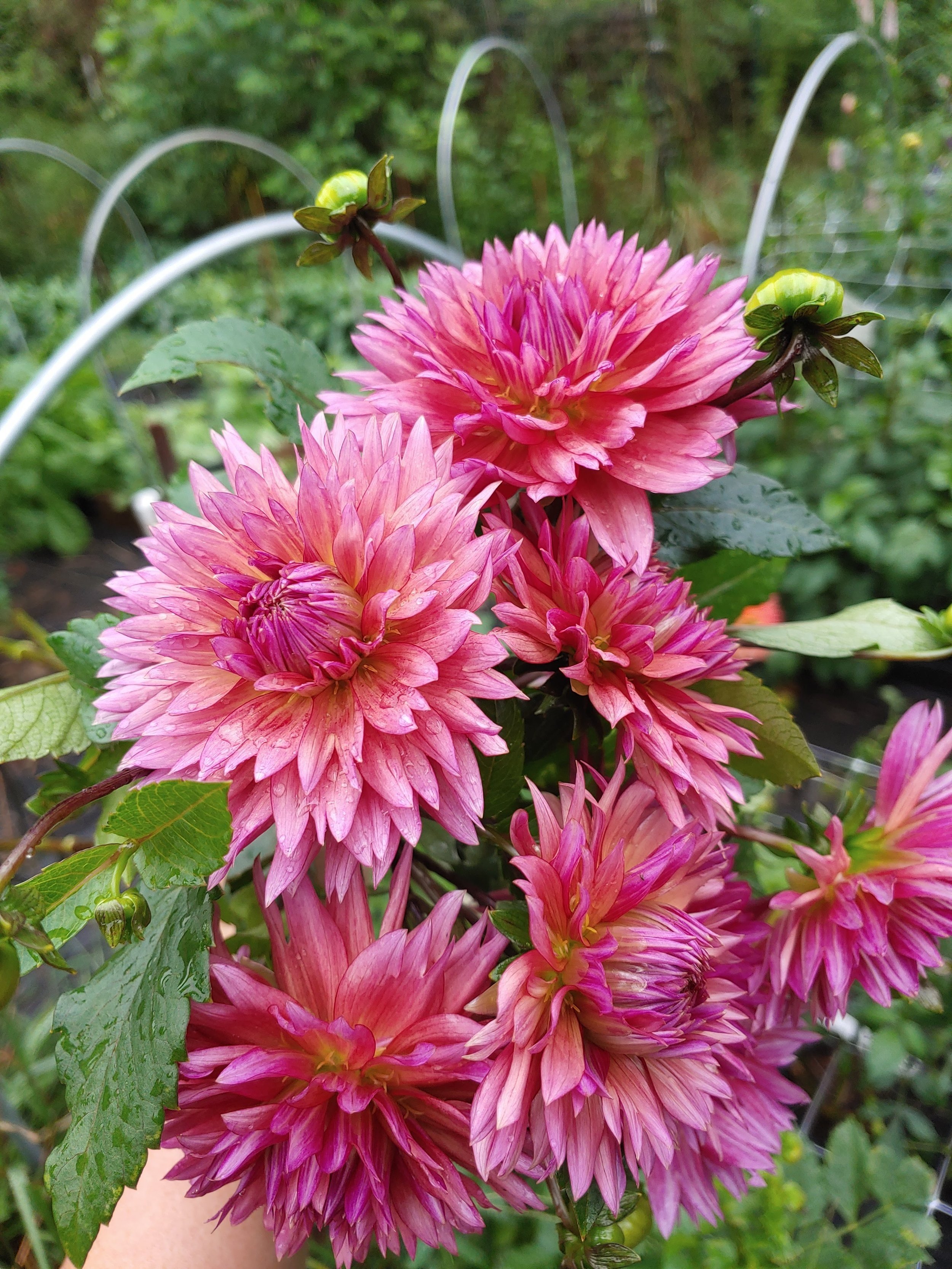
Sonic Bloom
So if you read through this and thought- but I still didn’t have the results I wanted with my dahlias.
***Read through again. Really look into each step and evaluate your growing. The majority of issues with growing dahlias can be traced back to the simplest things. ***
For example, for years, I always told myself- I’ll get the netting up before they get too tall! HA!!! And for years I had so many floppy plants- lost loads of stems that I could have sold! So now I put my netting up as soon as a row gets planted. The planting is not finished unless the support netting has been installed.
For the first several years, I didn’t soil test and I had lackluster blooms. They would be small or misshapen. I finally tested my soil and found I was very low in the crucial nutrients that create bountiful blooms.
It took me several years to really believe that I could cut 2’ stems on my dahlias without damaging the plants. But then I grew a variety that was 8’ tall. I had to cut long stems in order to keep it manageable. That taught me that if I cut the first stems long, then I would continue to have long usable stems throughout the season (instead of short weak ones).
All that to say— Don’t Ignore the Basics!!! When I see new growers who have bountiful blooms on healthy plants, I can always trace it back to following the basics.
So go grab a few tubers to try this year and then over the next few months, begin to plan how you will implement the basics in your garden. Follow along with me here, lots more info coming.

A Dahlia Year In Review: 2024
January is always a time of reflection and planning on the farm. I’ve been looking back at last year and forward into 2025. It’s going to be amazing for dahlias- I can just feel it! However I didn’t want to let the opportunity pass to write a review of 2024. It was interesting to say the least….
The year began in March with removing the covers from our over wintered dahlia trial. The plants were already sprouted when we removed the tarps in early March. We even got lucky last year and only had one mild frost after the tarp removal. This nipped the plants back just a bit but not much.

We also took loads of cuttings last spring to fill up our field with new varieties. We worked in a makeshift grow room last year and I’m so thankful for a much upgraded set up this year.

We planted all through May and June. We also harvested blooms during this time too- This was a new experience to be harvesting and planting at the same time. But we had blooms off our early over-wintered during May through June. At the end of June we cut those plants back to give them a break during the high heat of July. We also had some extreme heat temps in June which did cause some loss. Some of the later tubers we planted didn’t make it, they literally cooked in the ground. The rooted cuttings however did much better. Because they already have roots when planted- they establish much faster.


Left: Over wintered dahlias budding up
Center: First Blooms!
Right: Over wintered dahlias cut back and in need of some weeding
July and August came and went and we just did what we always do— Remained consistent in feeding and managing pests. It’s the only way to get through the yuck of summer and leads to beautiful fall blooms.
September came and we cut buckets and buckets of to die for blooms!


It was amazing until it wasn’t. In less than 24 hours, Hurricane Helene came through and left a wide swath of damage. We were lucky- most of the damage was in our woods with fallen trees. We still have damage to our barn to fix but it’s nothing compared to what so many experienced just an hour north of us.
From a dahlia standpoint, it did end our season early. We got about another week’s worth of blooms. We lost a lot of plants to rot in one of our fields that was just beginning to bloom for the season- several 1000’s of dollars worth of loss. We won’t really know the full loss until we pull back the tarps this March to see what tubers still remain. I’m fully planning on making extra cuttings to replace the ones that rotted. It was hard to tell at the end of the season. Several rows had 20-30’ of rot and then the rest would be fine. Overall the hurricane was also a big contributor to lower tuber yields this year too.
But that’s another reason I’m thankful for an upgraded grow room this year. We are growing lots of rooted cuttings for our farm and for sale!
Here’s to 2025— May she be free of extreme heat waves and devasting hurricanes!

Planning Your Cut Flower Garden With Dahlias
We all know that dahlias are the queen of any flower bouquet but every bouquet needs some supporting players. Earlier this week, I asked my crew what their favorites annuals were to plant with dahlias in a cut flower garden. I know every one is planning their summer gardens right now so read on for a bit of inspiration.
We are going to go in alphabetical order here:
Asters: These are a great early fall bloomer to complement dahlias. They do work better if you are a cool zone 7 or lower. Sadly I haven’t seen a lot of success for these in extreme heat climates. You need to know that they must be planted early in the season (April/May). They have to establish under shorter day lengths so plant with enough time for them to bulk up before the summer solstice. The decreasing of daylength after the solstice is what initiates the buds on them—therefore leading to a beautiful early fall bloom.
My Crews Top Picks:
Melissa- Tower Violet
Baylee- Tower Salmon


Celosia: These beauties are the opposite of asters. They love the heat! If you are in a cooler climate, you could try them inside a hoophouse, even a small backyard one might give you the extra heat needed to grow it. Celosia can be succession planted too- you can seed a set of them every month from March through July if you live in an area with a frost date of late October or later. Earlier than that, you would want to quite seeding in early June. Seeding transplants is definitely the way to go with celosia, you’ll get better results than direct seeding. But make sure to not leave your transplants in the trays too long- they don’t like to get rootbound.
My Crews Top Picks:
Melissa- Chief Persimmon
Nonah- Dragon’s Breath
Baylee- Flamingo Feather


Cosmos: You can never have too many cosmos in our opinion. We had a hard time picking just a few varieties! I like to direct seed cosmos. You can do transplants but they do very well from a direct seed and it saves time babying plants. Wait until the soil is very warm- don’t rush these into the ground immediately after your last frost date. Give it a few weeks and then they will pop out of the ground within a few days. If you choose taller varieties you may want to support or net them so they don’t fall over.
My Crews Top Picks:
Melissa- Rubenza, Bright Lights
Baylee- Double Click Bi-Color Violet, Apricot Lemonade
Nonah- Double Click Bi-Color Violet
Sophie- Rose Bon Bon


Gomphrena: Who doesn’t love the fun pop of color that gomphrena brings to a bouquet. They have such a sense of whimsy. You can succession plant these too if you want a continuous bloom all summer. Just start a new set of seeds about every 4 weeks until July. Begin seeding 4 weeks before your last frost date. Then plant after the frost clears. Pinch out the center when they are a few inches tall so that they will branch and give a lot of stems.
My Crews Top Picks:
Melissa- Firecracker
Baylee- QIS Pink
Nonah- Las Vegas Mix

Marigolds- These are the champions of fall. Such tough and hardy plants and there are so many new ones on the market these days. I grew to love marigolds again last year when we planted White Swan. Gorgeous butter yellow color and doesn’t have the strong smell of other varieties. Marigolds have a strong scent to their foliage and you either love it or hate it. These can be direct seeded very easily or transplanted- they work well either way and will sprout in a few days.
My Crews Top Picks:
Melissa, Baylee- Gem Series (specifically Lemon Star)
Nonah- White Swan

Zinnia: An easy to grow favorite! Zinnias really fill up a bouquet and the wide range of colors gives something for everyone! Start from direct seeding if your soil is sufficiently warm or transplants if you want to start the seeds early. Zinnias are another good one to succession plant. They tend to get fungus after a few weeks of blooming so good to plant multiple successions to have fresh blooms without brown spots.
My Crews Top Picks:
Melissa- Oklahoma Ivory and Benary Wine Red
Baylee- Ballerina
Nonah- Cherry Zydeco
Sophie- Queen Lime Red


So what are you going to grow with your dahlias this summer and fall. And most importantly— do you have enough dahlias?? The queens are important and there must be enough beauties to hold pride of place in your bouquet. If you need more- check out our dahlia tubers and cuttings!

Rooted Cutting Care 101
So you took the plunge and ordered some rooted cuttings! What do you do now? Well most likely you’ll be waiting a few months on them to arrive but it gives you time to prepare for their arrival.
When that magical box arrives- OPEN IT IMMEDIATELY! Don’t let it sit on the counter- you’ll forget about it. Remember it contains live plants that have been locked up in the dark for a few days. So even if you are busy, open it and open the plant enclosure and at least let the plants breathe. If they are dry, you can put them in cups with a 1/2” of water and let them slowly absorb it.
The environment you keep them in for the next few days is pretty important. Remember they’ve been growing in a warm 65 degree environment. So if it’s still on the chilly side outside, you don’t want to shock them. If you are hardcore and have grow lights in your spare bedroom (you know who you are!), place them under there until you can move them outside to begin to harden off.
So what is hardening off? It’s an expression you hear a lot in the plant world. It is the process of acclimating a plant to it’s environment. Most plants need around a week to adjust to a new environment.
Our goal is to ship your plants as close to your planting time as possible but it’s also hard for us to know the exact climate and timing all over the country. So you may have to give the plant a little care in the meantime.


Potting up your cutting into a 3” pot is also helpful. I highly recommend this for home gardeners who aren’t dealing with 1000’s of plants. Letting your cutting double in size before you plant it will only increase your chances of success. When planting, pull off the bottom set of leaves (the bottom 2) and then plant the node (the place where the leaves attach to the stem) under the soil level. By putting that node under the soil level, you just gave the plant another place to grow tubers from. So you are increasing the number of tubers you will get at the end of the season and also giving your plant a jump start on creating a healthy root system. You can also remove the bottom set of leaves again when you plant it in your garden (more nodes underground=more tubers).
Now say you don’t have grow lights and a protected place to keep your cutting. What do you do? Pot it up and then place it outside during the day so it can get good sunlight. (I don’t recommend window sills because usually the light isn’t strong enough). Make sure it’s at least 50ish outside. Then if it’s going to be freezing at night, bring it in.
But again - let me stress- the goal is to get your cutting to you within a week or two of your time to plant. However I know not every farm is the same and sometimes you might want a cutting really early- so now you know what to do with it.


So why would you want a cutting early? Well to propagate from it of course! You can take a cutting from a cutting. However I learned a bit about the timing on when to do that this summer while I was attending an ASCFG conference. I used to take the cutting as soon as the center had grown big enough for me to pinch out. But this causes the plant to branch too early and often results in two weaker stems. So let the plant grow on several nodes. I’m letting them grow to the 4th or 5th node and then taking the cutting from the center. This would be the same timing as pinching your plant back to create branching. Remember every time you pinch, you create more branches. So you want to be aware of how many pinches you take off a plant. I really think the process of having a plant that is just for cuttings is best (like you wouldn’t worry about planting it out) because taking too many can create weak stems and also lots of those weak stems.
So when do you plant? First off- you want to make sure you are past your last frost date. You also want to make sure your soil temps are at least 60ish. Planting a dahlia into cold soil does nothing to help it get going- it’s just going to sit there. So even if you are past your last frost date, you might want to wait just a bit for soil to warm up (but this also depends on what the current temps have been in your area in previous weeks). I use a cheap compost thermometer to check my soil temperature.
So let’s summarize:
1. Open your box immediately upon arrival. Offer water if cuttings are dry.
2. Harden off your cutting to acclimate it to your enviroment
3. Pot up your cutting to increase your tuber count and give it a head start on a healthy root system
4. Plant out once your last frost has passed and soil has sufficiently warmed.
A little TLC and your cutting will produce a beautiful healthy plant that will bloom a lot sooner than your tuber planted dahlias!